Accelerated TMS
Depression treatment in days, not weeks
The same stimulation, the same target, delivered on a schedule that fits a real life.
Available in Tomball, north of Houston | Patients travel in from across Texas
The problem was never the treatment. It was the calendar.
Standard TMS works. A standard course for depression is 36 sessions delivered over four to six weeks, and the evidence behind it runs two decades deep. The difficulty is what those weeks ask of you.
Students cannot step out of a semester. Working adults cannot leave the office every afternoon for a month and a half. Parents cannot arrange coverage three dozen times. And if you live three hours away, or in another state, the conversation tends to end before it starts.
So people do not begin. Not because TMS would not help them, but because the schedule says no.
Accelerated TMS exists to answer that specific problem. Instead of one session a day for weeks, you receive several sessions a day over a much shorter period. The stimulation is the same. The brain target is the same. What changes is the calendar.
What accelerated TMS is
Conventional TMS delivers one treatment session per day. Accelerated TMS delivers two or more. That is the whole idea: the same magnetic stimulation of the same region of the brain, compressed into fewer days by fitting more sessions into each one.
Two things made this practical. Standard TMS sessions became shorter: the original protocol ran close to 37 minutes, and the one we use now takes about 19. Then came intermittent theta burst stimulation, or iTBS, which delivers a session in 3 to 10 minutes depending on the protocol. Once a session takes minutes rather than most of an hour, several in a day becomes realistic.
Between sessions you rest. Those gaps are part of the treatment rather than downtime: the effect builds in the time between sessions, not only during them, which is why the spacing is set by the protocol and we keep to it.

What the FDA cleared, and when
On 26 May 2026, MagVenture, the manufacturer of the TMS system we use, received expanded FDA clearance covering accelerated treatment protocols. That clearance covers:
- Two to ten sessions per day, rather than a single daily session
- Both repetitive TMS and intermittent theta burst stimulation
- Delivery with or without MRI
- Adults with major depressive disorder who did not improve satisfactorily on antidepressant medication in the current episode
- Decreasing anxiety symptoms in those patients who also have comorbid anxiety
In plain terms: we can treat you several times a day, on a schedule that finishes in days or weeks rather than months, using the same stimulation that has been in clinical use for years.
MagVenture's full list of FDA clearances →Our accelerated protocols
MagVenture publishes four accelerated schedules. We offer the two that make a real difference to your calendar, alongside standard TMS and the One-Day Protocol. The table compares what each one asks of you.
| Protocol | FDA-ClearedStandard TMSOnce daily | FDA-Cleared3-Week AcceleratediTBS 3x/day | FDA-Cleared5-Day AcceleratediTBS 10x/day | Off-LabelONE-D (Single Day)iTBS 20x/day |
|---|---|---|---|---|
| Time commitment | 36 visits | 15 treatment days | 5 consecutive days, about 9 hours each | 1 visit, about 9.5 hours |
| Sessions per day | 1 | 3 | 10 | 20 |
| Total sessions | 36 | 45 | 50 | 20 |
| Session length | approximately 19 minutes | approximately 6 minutes | approximately 10 minutes | approximately 3 minutes |
| Self-pay cost | from $7,000 | $6,500 | $10,000 | from $2,500 |
| Insurance | Covered by most major plans when treatment-resistance criteria are met | Generally self-pay | Generally self-pay | Self-pay only |
| Best for | Patients with insurance coverage whose schedule allows daily visits | Patients within driving distance who want a shorter course with randomized trial evidence behind it | Patients travelling in, and anyone who can clear one week | Patients under the tightest time constraint, who accept a newer evidence base |
| Learn more | Standard | 3-Week | 5-Day | ONE-D |
Scroll the table sideways to compare all protocols.
All prices are all-inclusive: brain mapping, motor threshold determination, treatment, and follow-up assessments.
Cleared protocols, and one that is not
The three-week and five-day protocols are covered by the clearance described above. Standard TMS has its own, older clearance. The One-Day Protocol does not have FDA clearance and is offered off-label.
Off-label treatment is ordinary practice in medicine. A large share of prescriptions written in the United States every day are for uses outside a product's original labeling. It is legal, it is common, and it is how physicians apply established treatments to patients whose circumstances fall outside the population a trial happened to study. What it requires is a physician exercising clinical judgment on the basis of the available evidence, and a patient who has been told plainly what that evidence is.
For the One-Day Protocol, the evidence is early. It comes from a 32-patient case series, an 8-patient report, and a comparison of 106 patients treated in a single day against 191 treated on the standard daily schedule.
Why compressing the schedule works
The reasonable question is whether shortening the calendar weakens the treatment.
What matters is the total treatment, not the number of weeks
The amount of stimulation you receive across a course matters more than how long the course takes to deliver. Studies that pool results across accelerated protocols point the same way: the more stimulation delivered over a course, the better the outcome. Accelerated protocols give you a full course. They give it to you faster.
Both of the schedules we offer have been tested
The three-week schedule was tested in a 2025 trial published in JAMA Psychiatry, which gave three sessions a day for three weeks to 100 patients whose depression had not responded to medication. It worked and was well tolerated. The five-day schedule has been studied more, and each page covers its own research. Neither rests on a single trial: the FDA cleared accelerated delivery for two to ten sessions a day on the combined evidence for TMS, for theta burst, and for treating more than once a day.
Improvement usually comes in the weeks afterwards
Most people do not feel a great deal of change during treatment itself. Improvement builds over the weeks that follow, which is why response is judged then rather than on the last treatment day. A quiet first week is normal, and it is worth knowing that before you start rather than after.
Each protocol page covers the research behind that schedule in more detail.
Who accelerated TMS is for
If weeks of daily appointments is the obstacle between you and treatment, accelerated TMS exists to remove that obstacle. That includes:
- Students who cannot interrupt a semester
- Working adults who cannot leave every afternoon for weeks
- Parents and caregivers with limited coverage
- Patients traveling from outside the Houston area or from out of state
- Anyone whose previous attempt at TMS stalled because of the schedule
Accelerated treatment is for adults with major depression that has not improved on antidepressant medication during this episode of illness. That includes people whose depression comes with anxiety.
Standard TMS may be the better choice for you. If you have insurance coverage for it and your schedule allows daily visits, coverage typically brings your out-of-pocket cost well below self-pay accelerated treatment.
Accelerated protocols are FDA-cleared for adults. For patients aged 15 to 21, the standard daily schedule is the one the clearance covers and the one with the most evidence behind it in that age group. An accelerated schedule can be considered off-label, and that is a decision Dr. Nazarani makes with the family at consultation.
TMS is not appropriate for everyone. Metal implants in or near the head, a history of seizures, and certain neurological conditions are among the factors we screen for. Candidacy for any protocol is determined at consultation with Dr. Nazarani.
Cost and financing
Standard TMS is covered by most major insurance plans for FDA-cleared conditions, and we accept them. Accelerated protocols are generally not yet covered and are self-pay. The figures in the table above are all-inclusive course prices, not per-session rates.
CareCredit financing is available with six months interest-free. The monthly figures shown are approximate and assume the full balance financed over six months. We can also work with patients on pricing case by case.
Traveling for treatment
We regularly treat patients who travel to Tomball for accelerated TMS, from around Texas and from out of state. For a one-day or five-day protocol, that is a trip rather than a relocation.
Tomball
TMS AvailableTomball, TX 77377
- Tomball is about 30 miles northwest of downtown Houston, reachable from both George Bush Intercontinental (IAH) and William P. Hobby (HOU)
- The initial consultation with Dr. Nazarani can be done by phone or video before you travel
- For the five-day protocol, plan five consecutive weekdays; there are hotels within a short drive
- For the One-Day Protocol, plan a full day in clinic and arrange a ride home afterward
- Follow-up assessments are handled remotely
Who provides your treatment
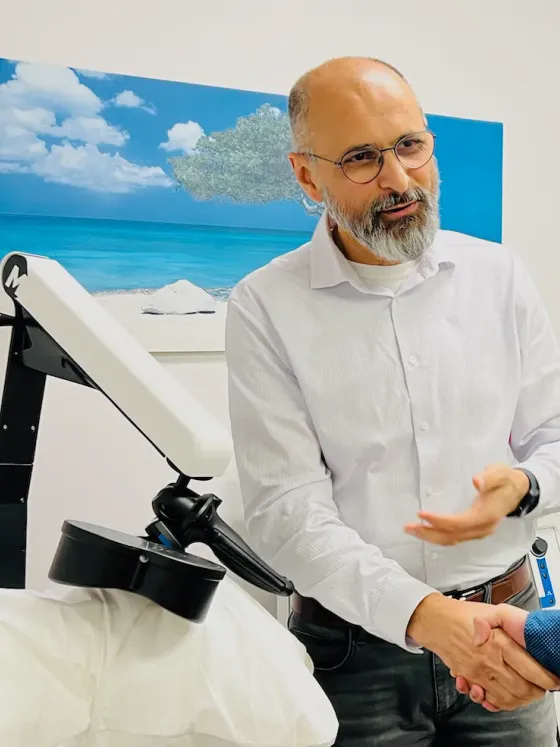
Accelerated TMS at Everhealth is delivered under the direction of Dr. Mehboob Ali Nazarani, a board-certified psychiatrist with nearly three decades of clinical experience who completed a Visiting Fellowship in Transcranial Magnetic Stimulation at Duke University Medical Center.
Every treatment plan, which protocol, whether TMS is appropriate at all, and what to expect, is determined by a psychiatrist. Not a technician, and not a sales coordinator. Dr. Nazarani personally evaluates every TMS patient, performs the brain mapping, and monitors response throughout the course.
Frequently Asked Questions
You will feel a tapping or clicking sensation on your scalp at the treatment site. Most patients find it mildly uncomfortable at first and adjust quickly, usually within the first few sessions. The most common side effects are mild scalp discomfort and headache, and both typically fade over the course of treatment.
TMS has been in clinical use for over 15 years. Serious side effects are rare and the risk of seizure is very low. It is not appropriate for everyone: metal implants in or near the head, a history of seizures, or certain neurological conditions may rule out candidacy. This is evaluated during your consultation.
Dr. Nazarani personally evaluates every TMS patient, performs the brain mapping, selects the protocol, and monitors your response throughout the course. The treatment sessions themselves are delivered by a trained TMS technician under his direction.
Dr. Nazarani completed a Visiting Fellowship in Transcranial Magnetic Stimulation at Duke University Medical Center. He is board-certified in psychiatry by the American Board of Psychiatry and Neurology, a member of the Clinical TMS Society, and has nearly three decades of clinical experience.
Not everyone responds. If treatment is not effective, Dr. Nazarani will discuss the alternatives with you directly. We are straightforward about this because setting realistic expectations is part of how the practice operates.
It depends on the protocol. A standard course starts from $7,000 self-pay, and is covered by most major plans for FDA-cleared conditions when treatment-resistance criteria are met. Accelerated protocols are self-pay at an all-inclusive course price: $6,500 for the three-week protocol, $10,000 for the five-day protocol, and from $2,500 for the One-Day Protocol. We review cost with you before treatment begins, CareCredit financing is available, and self-pay pricing is handled case by case.
It depends on the protocol, and Dr. Nazarani discusses the options at your consultation. A standard session takes approximately 19 minutes. A theta burst session takes approximately 3 minutes, which is a convenience and scheduling advantage rather than a clinical one, and most insurers do not yet cover it. Accelerated protocols fit several short sessions into a day: three a day over three weeks, ten a day over five days, or twenty in a single day.
A standard course for depression is typically 36 sessions over 4 to 6 weeks. A standard course for OCD is 30 sessions. Accelerated protocols deliver a full course in far less time: 45 sessions over three weeks, 50 sessions over five days, or 20 sessions in a single day. The number is determined at your consultation.
Yes. There is no sedation and no recovery period, so patients return to work, school, or their normal routine immediately after each session. If daily visits over 4 to 6 weeks do not fit your schedule, accelerated protocols compress the same course into three weeks, five days, or a single day.
In most cases, yes. Dr. Nazarani conducts a full medication review at your evaluation and advises on any adjustments needed before or during treatment.
TMS is available at our Tomball office at 14011 Park Drive, Ste 212, about 30 miles northwest of downtown Houston. On-site TMS at our Houston office is coming later this year. Patients regularly travel to Tomball from Cypress, Spring, The Woodlands, Magnolia, and Katy, and the One-Day Protocol is designed for patients traveling from farther away.
Conventional TMS delivers one session per day. An accelerated protocol delivers two or more, which compresses the same course into far less calendar time. The stimulation and the brain target do not change. What changes is how many sessions fit into a day, and theta burst stimulation is what makes that practical by bringing a session down to a few minutes.
No. The accelerated protocols on our MagVenture system are cleared for use with or without MRI or neuronavigation equipment, and we use validated scalp-based targeting. The dose and the schedule are identical either way.
What matters most is the total amount of stimulation you receive, not how many weeks it takes to deliver. Accelerated protocols give you a full course. Both of the accelerated schedules we offer have been tested in controlled trials, and the five-day schedule in several. Standard TMS still has the longest track record of any approach, and it may be the better option if your schedule and your insurance both allow it.
Generally not yet. Standard TMS is widely covered for FDA-cleared conditions and we accept most major plans. Accelerated protocols are currently self-pay, priced as an all-inclusive course rather than per session, with CareCredit financing available over six months interest-free.
Yes, and patients do. The initial consultation with Dr. Nazarani is conducted by phone or video before you travel, so your time here is treatment time, and follow-up assessments are handled remotely as well. Tomball is reachable from both Houston airports and there are hotels within a short drive.
The accelerated clearance on our system covers adults. For ages 15 to 21, the standard once-daily schedule is what the adolescent clearance covers and what has the most evidence behind it, so it is where we normally start. An accelerated schedule can be considered off-label for a younger patient, and Dr. Nazarani decides that with the family at consultation rather than in advance.
References
The clinical claims on this page and its protocol pages are drawn from the following sources.
- Ramos MRF, Goerigk S, da Silva VA, et al. Accelerated Theta-Burst Stimulation for Treatment-Resistant Depression: A Randomized Clinical Trial. JAMA Psychiatry. 2025;82(5):442-450.
- Taylor JJ, Kurtz MM, Siddiqi SH, et al. Connectivity- vs Scalp-Based Targeting of Accelerated Transcranial Magnetic Stimulation for Depression: A Randomized Clinical Trial. JAMA Psychiatry. 2026.
- Cole EJ, Phillips AL, Bentzley BS, et al. Stanford Neuromodulation Therapy (SNT): A Double-Blind Randomized Controlled Trial. American Journal of Psychiatry. 2022;179(2):132-141.
- Cole EJ, Stimpson KH, Bentzley BS, et al. Stanford Accelerated Intelligent Neuromodulation Therapy for Treatment-Resistant Depression. American Journal of Psychiatry. 2020;177(8):716-726.
- Blumberger DM, Vila-Rodriguez F, Thorpe KE, et al. Effectiveness of theta burst versus high-frequency repetitive transcranial magnetic stimulation in patients with depression (THREE-D): a randomised non-inferiority trial. Lancet. 2018;391(10131):1683-1692.
- Pettorruso M, Borgi M, Padula LP, et al. Meta-regression insights for optimizing accelerated neuromodulation protocols in major depression. Journal of Psychiatric Research. 2025;192:289-295.
- Vaughn DA, Marino B, Engelbertson A, et al. Real-world effectiveness of a single-day regimen for transcranial magnetic stimulation using Optimized, Neuroplasticity-Enhanced techniques in Depression (ONE-D): An open-label case series. Transcranial Magnetic Stimulation. 2025;5:100116.
- Kratter IH, et al. Stanford neuromodulation therapy for treatment-resistant depression: a randomized controlled trial confirming efficacy, and an EEG study providing insight into mechanism of action and a potentially predictive biomarker of efficacy. World Psychiatry. 2026;25(1):105-116.
- Geoly AD, Stimpson KH, et al. Durability of clinical benefit with Stanford Neuromodulation Therapy (SNT) in treatment-resistant depression. Brain Stimulation. 2025.
- Wang VX-Y, et al. Dose-response associations of total pulse dose and intersession interval with clinical outcomes in accelerated rTMS for major depressive episodes: A systematic review and meta-analysis. Brain Stimulation. 2026;19(4):103129.
- Rush AJ, Trivedi MH, Wisniewski SR, et al. Acute and longer-term outcomes in depressed outpatients requiring one or several treatment steps: a STAR*D report. American Journal of Psychiatry. 2006;163(11):1905-1917.
- MagVenture. Accelerated TMS for MDD. Product literature, document 2026_03_13_01_rev1_US.
- MagVenture. FDA Clearances. https://magventure.com/us/fda-clearances/
Learn More About TMS
 Depression
Mehboob Ali Nazarani, M.D. · Oct 11, 2026 · 10 min read
Treatment-Resistant Depression: What It Is and What to Do Next
What treatment-resistant depression (TRD) means, why antidepressants may not work, and the options that remain, from medication changes to TMS.
Read article Depression
Mehboob Ali Nazarani, M.D. · Sep 26, 2026 · 8 min read
Why Can't I Feel Happy Anymore? Causes of Emotional Numbness
Can't feel happy anymore? A psychiatrist explains anhedonia, the inability to feel pleasure: its causes, how it differs from numbness, and its treatment.
Read article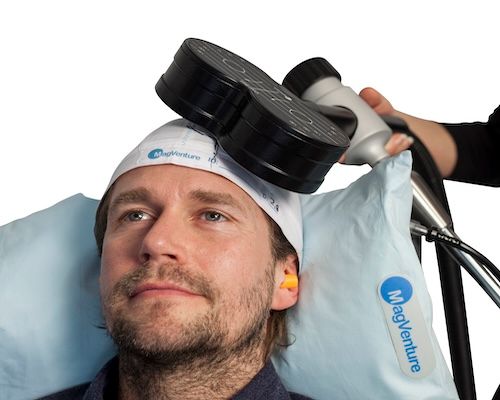 Depression
Mehboob Ali Nazarani, M.D. · Dec 10, 2024 · 3 min read
Is TMS Appropriate for Me?
Who TMS is a good fit for, who it is not, and the questions your psychiatrist will work through with you before recommending it.
Read articleIf the schedule is what has been stopping you, it is worth a conversation
We typically schedule a phone consultation within one business day of your request. There is no obligation, and if standard TMS or a different approach makes more sense for your situation, we will tell you that.